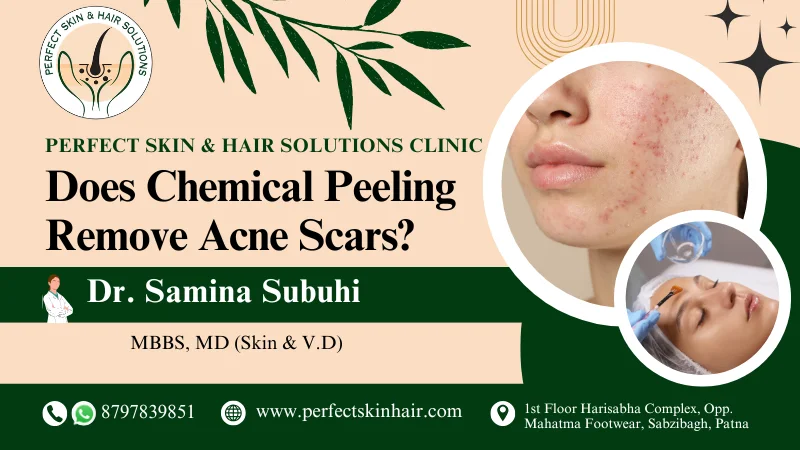
Acne scars don’t just steal natural beauty from your face but are also majorly responsible for low self-esteem and cause individuals the most worrisome questions about their appearance. They come in many forms. Some acne scars are hyper-pigmentation while others have little to big cavities that make your skin appear depressed or pitted.
With treatment, many acne scars can fade away on their own over time, but there are stubborn scars that can be very hard to treat with normal cosmetic procedures. Laser surgery is known to be an evolving treatment that requires huge expenses, so most patients generally go for a simple, minimally-invasive, side-effect-free procedure known as Chemical Peeling Treatment.
This treatment helps in improving the outer skin layer texture and skin quality, as well as diminishing all types of scars, especially acne scars.
But the question many people ask is: Does chemical peeling actually remove acne scars?
To clear this query, let’s discuss about the process of chemical peels, what studies have to say about it and what dermatologists think about it and also know about other alternatives.
Does Chemical Peeling Remove Acne Scars?
A chemical peel exfoliates the top layers of the skin using a chemical solution. It removes the damaged and dead cells, causing the dead skin to peel.
When the upper layer is removed, the peel causes the skin to exfoliate, leaving behind a new, unblemished layer of skin, which promotes cell renewal, as well as collagen production, and ultimately leads to a rejuvenated, restored and healthier look of your skin.
Many claim that when a chemical peel is performed properly, it can help to improve the overall texture of the skin, reduce the visibility of mild superficial pigmentation, and help to create a less noticeable appearance of fine to moderate acne scars.
Chemical peels essentially smooth out your skin so you don’t have layers anymore. They also help with gradual improvement by having recurring sessions.
Since you now have a basic understanding of what chemical peels are, let’s look into some studies regarding how effective they are as a facial.
What the Research and Experts Say?
Research supports the use of chemical peels for improving mild to moderate acne scars, particularly when treatments are customized for Indian skin types. A comparative study published in the Journal of Cutaneous and Aesthetic Surgery evaluated 70% glycolic acid (GA) and 30% trichloroacetic acid (TCA) peels in patients with atrophic acne scars.
This highlights that carefully selected medium-depth peels can significantly improve acne scar appearance over multiple sessions.
Additionally, guidelines published in the Indian Journal of Dermatology, Venereology and Leprology (IJDVL) emphasize safety considerations for Indian skin, stating:“Superficial peels are considered safe in Indian patients. Medium depth peels should be performed with great caution in dark-skinned patients.”
(Link: https://ijdvl.com/standard-guidelines-of-care-for-chemical-peels/)
Together, these studies show that chemical peels are beneficial in the treatment of acne scars — but only when choosing an appropriate peel strength and having it administered by a dermatologist.
How Effective Are Chemical Peels?
There are several factors that determine how well acne scarring will respond to chemical peeling, such as the nature of scarring, the strength of the chemical peel solution, and skin type.
Fortunately, the majority of people can experience considerable improvement with their scarring through a properly customized chemical peel session.
Here’s what you can expect:
- Helps in Achieving Smoother Skin – Due to the peeling process, the dead skin on top is stripped away.
- Clearer Skin – Chemical peels decrease the amount of melanin that your body produces, which will result in lighter areas where you have had previous acne.
- Achieving a Brighter, More Even-Toned Complexion – Having regular chemical peel sessions can brighten your complexion.
It should be noted that the effectiveness of a chemical peel for removing the effects of scarring can vary depending on how severe it is.
Most chemical peels do little to nothing to improve deep scarring, but many types of chemical peels can make small to moderate surface scarring look better as well as lighten the appearance of some surface skin color irregularities (such as post-inflammatory hyperpigmentation).
As chemical peels only act on the surface of the skin, there are many things that we can use in conjunction with a chemical peel to enhance its effects on the acne scarring.
Alternatives to Chemical Peeling
Chemical peeling is an effective option, but it is by no means the only treatment for acne scarring.
There are many alternative or indeed complementary treatments that may be recommended depending on the nature of your scars. These include:
1. Microneedling
Microneedling for acne scars uses extremely fine needles to create tiny holes in the skin, which helps stimulate collagen re-modeling and the rejuvenation of the skin. This procedure is effective for rolling-type scars as they react very positively to a deeper penetration of the skin.
2. Laser Treatments
Laser resurfacing promote the formation of collagen in the outermost layer of the skin and tighten the skin. The most beneficial use for laser resurfacing would be for scarring that is more pronounced.
3. Dermal Fillers
Temporary fillers can be placed into depressed areas of the scar to allow the body the opportunity to heal itself over time.
4. Subcision
Subcision is a procedure that utilizes needles to separate adhesions of scar tissue beneath the surface of the skin. When done properly, this will elevate the deep portion of the scar and possibly remove irregularities from the contours of the skin.
Each method has unique advantages and disadvantages and should be applied appropriately. In some situations, using one of the above methods in combination with a chemical peel could provide the best possible outcome; the key to achieving the best outcomes is working with a skilled practitioner who develops a treatment plan that addresses the individualized needs of the skin.
So now that we know what can be done about chemical peels. Lets conclude.
Conclusion
So, can chemical peeling remove acne scars? The answer is yes, but with certain conditions.
If done appropriately, the chemical peeling treatment can help to improve the skin texture and hence fade away mild to moderate acne scars. The above statement is also proved by research and confirmed by dermatologists.
Chemical peels are not appropriate for all types of scars and may need to be combined with other treatments for deep scars.
Everyone’s skin is different, and that’s why it is very important to get your peeling done from an expert dermatologist who can assess your skin and advise which peel will suit you best.
At Perfect Skin & Hair Solutions Clinic, we provide the best dermatology services in Patna with complete individualised care and an evidence-based approach. Our dermatologist, Dr. Samina Subuhi, specializes in the evaluation of your skin and in suggesting a treatment plan that is most suitable for you.
A chemical peel can be a wonderful and effective skincare treatment when used in conjunction with a complete holistic approach to skincare. But, to use these peels successfully, one must understand their potential and be guided in the right way of using them for one’s specific skin.
And most of all, patience and good skin care practices are essential to turning severely acne scarred skin into truly healthy-looking, glowing skin.
Give yourself confidence with skin you love at the top rated dermatology clinic in Patna. Schedule your appointment today with Perfect Skin & Hair Solutions Clinic for healthy, glowing skin!