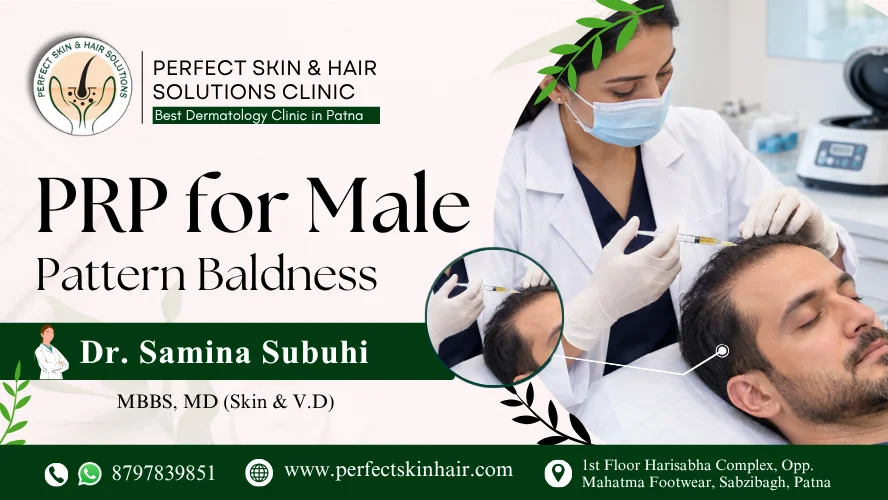
Male pattern baldness is a common form of hair loss in men and can present over time as thinning around the temples, crown and hairline. Many men consider non-surgical solutions to encourage hair growth and density.
PRP for male pattern baldness is one of these treatments. PRP involves a very small sample of blood that is used to create the treatment. The blood is injected with a concentration of serum and platelets that is a fraction of the original blood, thereby enhancing the growth factors.
The growth factors may stimulate the health of the hair follicles you already have. But results are unpredictable and will depend on where you are in your hair loss journey and how your body responds to the PRP treatment.
So, in this blog, we will look at how PRP treatment works, who may get benefits and comparison with the other treatment option.
Does PRP Hair Treatment Work for Male Pattern Baldness?
PRP for male pattern baldness may help some men with thinning hair, especially when the follicles are still active. The treatment uses components from the patient’s own blood to support existing follicles and encourage healthier hair growth.
A small amount of blood is collected and processed to separate the platelet-rich plasma. This plasma contains growth factors that may support follicle activity. It is then injected into areas where the hair has become thinner. The PRP hair treatment success rate can vary, and improvement usually takes time.
Supports Weak or Thinning Follicles
The hair follicle can also become depleted over time as the hair loss continues. The hair that grows back on the depletion can be finer and shorter. This treatment helps to nurture the depleted hair follicle back to life and promote hair growth. Additionally, placenta contains growth factors that can encourage an environment to support the follicle. But, it also depends on the stage of follicle depletion and hair loss.
May Improve Overall Hair Density
A fuller appearance may be observed in the treatment area with hair that is slightly or moderately thin, if existing hair follicles have adequate response. It does not, however, indicate that the amount of hair that has been lost will return. This varies from individual to individual, depending on the degree of hair loss, living follicles, scalp condition, age and individual response.
Provides a Non-Surgical Treatment Option
Unlike hair transplantation surgery, nothing is cut or implanted. The prepared plasma is injected back into the scalp in small amounts in targeted areas. The injections create little skin punctures but no cuts and no anesthesia, although some patients may notice increased redness, slight swelling and pressure, tenderness and scalp discomfort, with the effects diminishing within a few days.
PRP hair treatment for men is the best option for patients who are not seeking to have a surgical procedure. Although, it depends upon their type of hair loss and condition of their scalp.
Works Better When Follicles Are Still Active
A crucial aspect is whether the follicles in the previous area are still healthy. The procedure is meant to help hairs that are weak or producing thin hairs, not to restore follicles that have already been lost permanently. If an area has been bald for an extended period of time and the follicles are no longer functional, there is less room for improvement.
Consequently, it is essential to have an assessment prior to treatment. A dermatologist will examine the scalp, determine the degree and extent of the hair loss and determine whether treatment will be suitable.
Who May Benefit from PRP?
This solution could work well for men whose hair is thinning but still growing. You can have your condition checked by the best female dermatologist in Patna to understand whether it is suitable for your type and stage of hair loss.
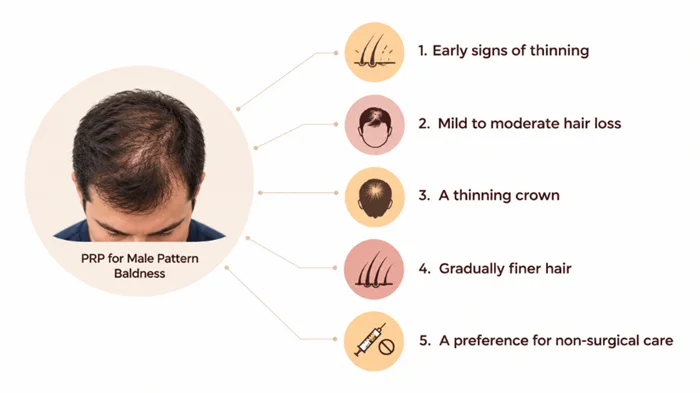
It may be considered for:
- Early signs of thinning: Men who have recently noticed hair loss may still have many active follicles. Supporting these follicles early may help maintain existing hair and improve its appearance.
- Mild to moderate hair loss: When thinning is noticeable but some hair remains in the affected areas, there may be more scope for improvement.
- A thinning crown: The crown is a common area affected by gradual hair loss. If the follicles are weakened but still functioning, treatment may help support them and make the area appear fuller.
- Gradually finer hair: When hair becomes thinner over time rather than disappearing completely, the follicles may still be producing hair. Supporting these follicles may help improve the appearance of the strands.
- A preference for non-surgical care: Men who do not want a surgical procedure may consider this approach because it does not involve removing or transplanting hair from another part of the scalp.
However, if permanent follicles have been lost or damaged, then this treatment might only be of minimal benefit. Hence the cause, pattern and stage of hair loss should be assessed initially. The dermatologist will be able to look at the scalp and decide if it is suitable.
What Happens During PRP Treatment?
If you know what to expect during PRP hair treatment in Patna, the process becomes much less unfamiliar. It is a quick outpatient treatment where your blood is drawn, processed and then injected into the area that requires assistance.
- Blood collection: A small amount of blood is drawn from your arm, similar to a routine blood test.
- Blood processing: The sample is placed in a centrifuge to separate the platelet-rich plasma from other blood components.
- Plasma preparation: The concentrated plasma is collected and prepared for injection into the scalp.
- Scalp injections: Small injections are given across areas where the hair has become thinner. The number of injections depends on the area being treated.
- After the procedure: Mild redness, swelling, tenderness, or discomfort may occur around the injection sites. These effects usually settle within a short period.
There are no surgical cuts or hair grafts involved in this process. Your dermatologist will even suggest some aftercare tips for maintaining healthy hairs.
Is PRP Better Than GFC?
PRP and GFC are non-invasive hair therapies that require extracting certain elements from the blood of the patient.
But, the techniques that are used to prepare and utilize these elements are quite different. Hence, it cannot be said that one hair loss treatment is superior to the other.
- PRP: Platelet-rich plasma contains concentrated platelets and growth factors. It is injected into areas of the scalp where the hair has become thinner.
- GFC: Growth factor concentrate is prepared by separating and concentrating specific growth factors from platelets before they are applied to the scalp.
- Treatment approach: PRP may be considered when the goal is to support weakened or thinning follicles. GFC also aims to provide growth factors directly to the scalp.
- Choosing between them: The appropriate option depends on the cause and stage of hair loss, follicle condition, scalp health, and individual treatment goals.
Both treatments take patience since hair growth isn’t instantaneous. A dermatologist can then take a look at your scalp and suggest the most effective option. And also will clear your myths about PRP hair treatment.
Why Choose Dr. Samina Subuhi?
If you are considering PRP treatment in Patna, Perfect Skin & Hair Solutions Clinic provides PRP treatment for hair concerns. The clinic is led by Dr. Samina Subuhi, a dermatologist and cosmetologist.
The clinic focuses on understanding individual hair and scalp concerns before suggesting a suitable treatment approach. This is important because the cause and stage of hair loss can differ from person to person.
If you are a man whose hair is gradually thinning, talking with us about PRP may help you to decide whether the treatment is right for you, and what the outcome might be. If you’re experiencing hair thinning or early-stage male pattern baldness, consult Dr. Samina Subuhi to understand whether PRP may be suitable for you.
Get Your Confidence Back with Healthy Hairs
For men with thinning hair, PRP for male pattern baldness may be one of several treatment options, especially if the condition of the current follicles is still good. However, results can vary and it is not able to bring back follicles that are gone for good, so the cause and extent of loss is worth knowing first.
If you are concerned about hair thinning, receding hairline or getting a flatter head of hair, Dr. Samina Subuhi at Perfect Skin & Hair Solutions Clinic can inform you on what is going on and what options you have.
A consultation would help you see if you are a candidate for PRP and the possible results.
FAQs
Here are some common questions men may have before considering PRP treatment for hair loss.
Can PRP fix a receding hairline?
PRP for receding hairline may help support existing follicles when they are still active, but it cannot restore permanently lost follicles.
How much does PRP cost for hair?
The PRP hair treatment cost in Patna ranges from ₹2,500 – ₹7,000 per session, with advanced centres charging up to ₹15,000.
Does PRP regrow hair permanently?
PRP may support existing hair follicles, but it does not guarantee permanent hair regrowth.
Is PRP hair painful?
PRP may cause mild discomfort, tenderness, or a brief stinging sensation during scalp injections.
Is 2 sessions of PRP enough?
Two sessions may not be enough for everyone, as the number of sessions depends on the extent of hair loss and individual response.